


Why more training days aren’t necessarily better when building muscle is the goal
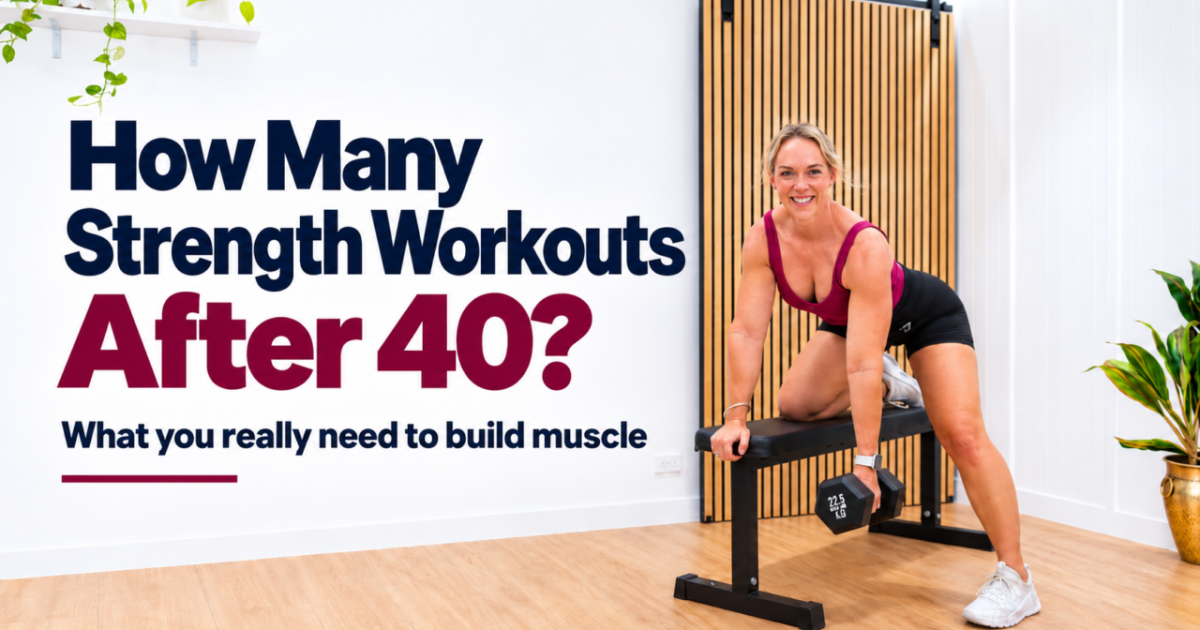
How many strength workouts after 40 do you actually need to build and keep muscle? Probably fewer than you think, and here’s why.
If building and maintaining muscle has become a bigger priority for you after 40, you might be wondering how often you actually need to strength train.
Do you need three days a week? Four? Five? Do you need separate leg days and upper-body days? Or can full-body workouts do the job?
The good news is that you probably don’t need to train as many days as you think.
What matters much more is whether you’re training the major muscle groups consistently, challenging them enough and getting enough quality work across the week to actually create progress.
And I think that distinction is really important, especially if your energy and recovery aren’t what they used to be.
So How Many Strength Workouts After 40 Do You Actually Need?
For general strength and muscle health, current resistance-training recommendations suggest training all the major muscle groups at least twice per week.
That doesn’t necessarily mean two full-body workouts are the only way to do it.
You could train full body twice. You could do upper body and lower body across several sessions. You could use a push/pull/legs style split. Or you could combine different types of workouts throughout the week.
The exact split matters far less than whether you are actually giving your muscles enough quality work.
Research comparing full-body and split routines has found very similar improvements in strength and muscle growth when the total amount of training is matched.
So there isn’t one magical training split we all need to follow after 40.
Two Strength Workouts Can Absolutely Be Enough
If you’re new to strength training, coming back after a break, short on time or simply trying to build a routine you can actually maintain, two well-designed strength workouts each week can be a brilliant place to start.
Ideally, between those two sessions you would train all the major muscle groups. And those workouts need to actually challenge you.
This is where I think the word strength training can become a little misleading. Holding dumbbells doesn’t automatically make something a muscle-building workout.
If you’re using a weight you could comfortably lift for another 30 repetitions, you probably aren’t giving the muscle much reason to adapt.
You don’t need to destroy yourself, but you do need enough resistance that the muscles are genuinely working.
If Building Muscle Is the Goal, Weekly Volume Becomes Important
This is where things get a little more interesting.
The latest resistance-training recommendations from the American College of Sports Medicine suggest that muscle growth tends to benefit from a higher weekly training volume, with around 10 sets per muscle group per week being a useful target when hypertrophy is the goal.
That number isn’t a rule. You don’t need to walk around the gym with a calculator panicking because your quads only got nine sets this week. 😂
But it gives us something useful to think about.
If you’re only doing one quick strength workout each week, it can be difficult to get enough quality work for every muscle group. Three or four sessions can make it much easier to spread that work across the week without making every workout ridiculously long.
That’s one of the reasons I’m enjoying more focused lifting sessions at the moment. I can give a muscle group enough attention without trying to cram every exercise I know into one workout.
Three Strength Days Is a Really Useful Middle Ground
For a lot of women, I think three strength-focused sessions can work incredibly well.
You might do:
- Lower body
- Upper body
- Full body
Or perhaps three full-body sessions with slightly different exercises and priorities. You could also have two dedicated lifting sessions and one workout that combines strength with conditioning.
There are lots of ways to organise it. The important part is that across the week your muscles are getting enough work and you’re recovering well enough to continue progressing.
You don’t earn extra points for lifting six days a week if you’re exhausted and every workout becomes half-hearted.
Four Days Can Make Muscle-Building Even Easier to Organise
If building muscle is a major goal and you enjoy lifting, four sessions can give you even more room to spread out your training volume.
For example, you might use an upper/lower split:
- Upper body
- Lower body
- Rest or lighter movement
- Upper body
- Lower body
That allows you to train the major muscle groups twice per week without needing enormous workouts.
But again, four days isn’t automatically better than three. Your training has to fit into your actual life.
If four sessions means you consistently train well and recover well, brilliant. If four turns into six because you feel like you’re never doing enough, we’ve probably missed the point.
This Week’s Workouts Are a Perfect Example
The two workouts I released this week have completely different jobs, but together they show how you can start building out a balanced week.
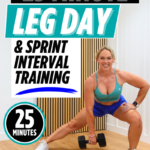
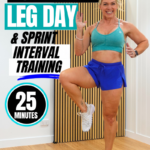
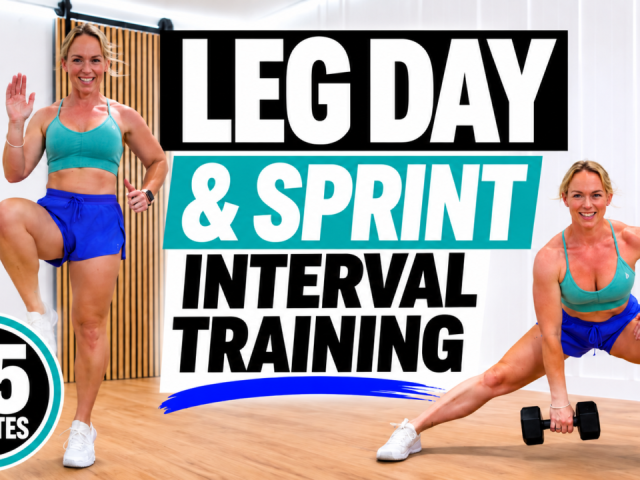
On Garage Fitness Girl, I released a new 25 Minute Leg Day + SIT Workout. You get focused lower-body strength work along with short sprint intervals, so it’s a really efficient way to combine resistance training and conditioning when you want both.
Then over on GFG Lifts, my new 35 Minute Upper Body Push + Pull Workout is much more focused on muscle building.
We’re training the major pushing and pulling muscles of the upper body, giving the exercises the attention they need and making the resistance work the priority.
Put those two sessions into the same week and you’ve already trained a huge amount of your body.
From there, another full-body strength session or another appropriately programmed lower or upper-body session could round things out depending on your goals.
You don’t need seven different workouts. You need enough of the right ones.
Full Body or Split Training?
This is another question I get asked a lot, and the answer is refreshingly simple. Both work.
A systematic review comparing split routines with full-body resistance training found no meaningful difference in muscle growth or strength when weekly training volume was matched.
So if you love full-body workouts, keep doing them. If you love having a dedicated leg day and being able to really concentrate on one area, do that. If your schedule changes from week to week, you can even use a combination.
I think we sometimes make programming much more complicated than it needs to be. The muscles don’t know what your workout split is called. They respond to the work you give them.
What Matters More Than the Number of Days?
If building muscle is the goal, I care much more about the quality of your training than whether you can say you worked out five times this week.
Are you using weights that genuinely challenge you? Are you getting enough quality sets for the muscles you want to develop? Are you gradually increasing the challenge over time?
Are you training consistently enough that your body has a reason to adapt? And are you recovering well enough to actually perform those workouts properly?
Those things matter. Simply adding another workout because you think more must be better isn’t necessarily going to get you there faster.
What About Cardio?
You definitely don’t need to abandon cardio just because you’ve decided muscle matters. I certainly haven’t. I walk every day, and I still love conditioning.
But as I talked about in last week’s blog, I’ve become much more intentional about where that conditioning fits.
Some days it might be a few short SIT intervals after lifting. Sometimes it might be built into a workout like this week’s Leg Day + SIT. Other times I’m perfectly happy to let a strength workout be purely strength focused and get my cardio elsewhere.
The goal isn’t to choose one or the other. It’s to make sure the cardio isn’t constantly replacing the muscle-building work you actually need.
You Don’t Need a Perfect Programme
I think this is one of the most useful things to remember.
There is no magical four-day split for women over 40. There is no special perimenopause training schedule that everybody suddenly needs to follow.
You need enough resistance training to challenge all the major muscle groups consistently, enough weekly work to support your goals and enough recovery that you can keep progressing.
For one woman that might be two strength workouts. For another it might be three. For someone who really loves lifting and wants to prioritise muscle growth, it might be four.
When it comes to how many strength workouts after 40 you need, the best amount is the amount that gives you enough stimulus to make progress without constantly feeling like you’re trying to recover from your training.
A Simple Place to Start
If you’re reading this thinking, “Okay Penny, just tell me what to do,” I’d keep it very simple.
Start by making sure you’re training all your major muscle groups at least twice across the week. That’s the simplest answer to how many strength workouts after 40 you need as a baseline.
If building muscle is becoming a bigger goal, gradually increase the amount of quality resistance work you’re doing rather than simply adding more and more random workouts.
Pay attention to your weights. Try to progress them over time. Give your muscles enough recovery.
And remember that the goal isn’t to fit as much exercise as possible into seven days. It’s to give your body enough of the right training to actually change.
Try This Week’s Workouts
For lower-body strength plus a short conditioning hit, try my new:
25 Minute Leg Day + SIT Workout
And if you want a dedicated muscle-building upper-body session:
35 Minute Upper Body Push + Pull Workout | GFG Lifts
Two completely different workouts. Both can have a place in a well-designed training week.
Penny x