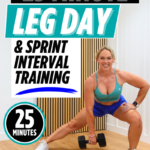
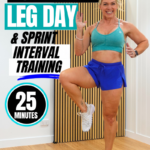


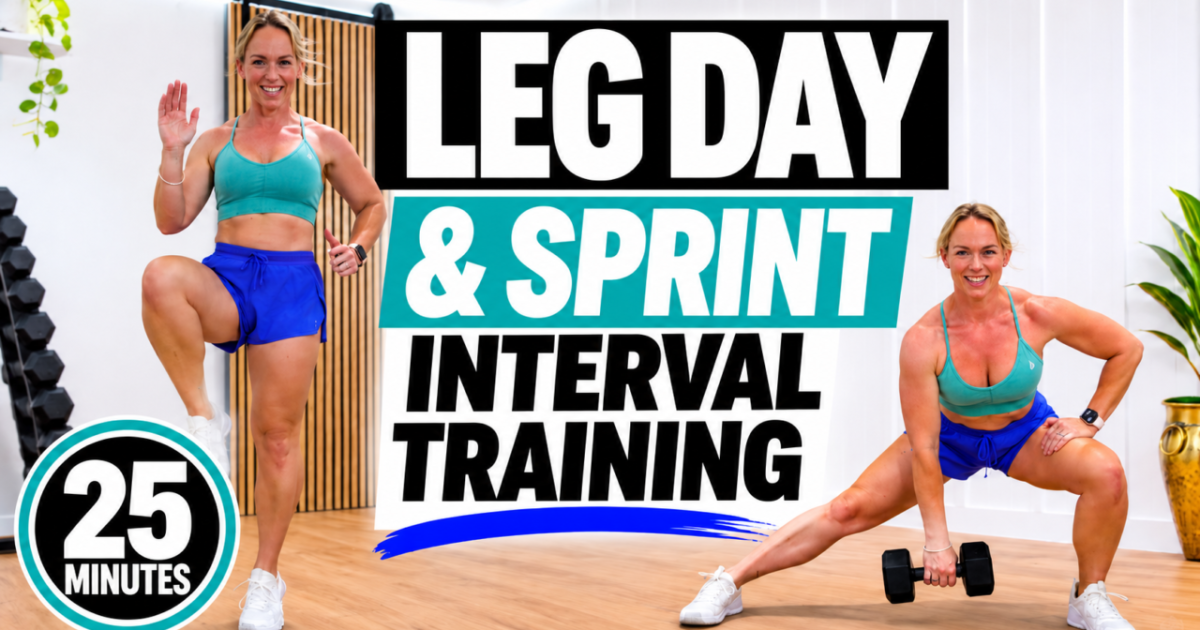
Short on time but still want to build stronger legs, maintain lean muscle AND get your heart pumping? This 25-minute leg day sprint interval workout combines challenging dumbbell strength training with short bursts of conditioning, giving you the best of both worlds without spending an hour exercising. ⚡
Heavy Legs, Short Sprints, the Best of Both Worlds
Some days I want to lift heavy. Other days I love getting my heart rate up. And honestly? Sometimes I want a bit of both! That’s exactly why I’m loving these strength and sprint interval workouts right now.
Instead of rushing through endless exercises or turning leg day into one long cardio session, we’re keeping the strength work purposeful and the conditioning short and punchy.
You’ll work through three lower body strength tri-sets, targeting your quads, hamstrings and glutes, with two short sprint interval training (SIT) blocks to challenge your cardiovascular fitness.
The best part? You only need one pair of dumbbells, a little space and around 25 minutes.
It’s a great option for those busy days when you still want to train with intention, challenge yourself and finish feeling like you’ve accomplished something. Grab your dumbbells and let’s get into it! 💪
What You’ll Gain
✔️ Stronger legs and glutes. Challenge your quads, hamstrings and glutes with focused strength training that supports lean muscle.
✔️ Better single-leg strength and stability. Unilateral exercises help you work each side independently and identify strength or balance differences.
✔️ Improved cardiovascular fitness. Short sprint-style intervals challenge your heart and lungs without needing a separate cardio session.
✔️ Quality effort with proper recovery. The 20-second sprint intervals are followed by 40 seconds of rest, giving you time to prepare for your next effort.
✔️ A time-efficient lower body workout. Combine strength and conditioning in one session that fits into a busy schedule.
Workout Overview
| ⏱ Duration | Approximately 25 minutes |
| 🔥 Calories | Around 228 (my workout estimate; individual results vary) |
| 🏋️ Equipment | One pair of dumbbells, an exercise mat and a wall |
| 💪 Focus | Quads, hamstrings, glutes and cardiovascular conditioning |
| 📊 Level | Intermediate, with modifications available |
| 🎯 Format | 3 strength tri-sets × 2 rounds (35s work / 15s rest), plus 2 SIT blocks × 2 rounds (20s work / 40s rest) |
Why This Leg Day Sprint Interval Workout Works for Women Over 40
Strength training helps you maintain muscle as you age. If there’s one thing I encourage women to prioritise as they move through their 40s and beyond, it’s strength training.
As we age, maintaining muscle becomes increasingly important, and the hormonal changes associated with perimenopause and menopause can make preserving muscle and bone health an even bigger priority.
Regular resistance training is one of the most effective ways to support muscle strength, physical function and bone health. You can read more about strength training during perimenopause here.
That’s why I love making proper strength work the foundation of these sessions. We’re not just moving weights quickly to get sweaty. We’re giving our muscles a reason to get stronger.
With exercises like squats, lunges, deadlifts and glute bridges, you’ll challenge the major muscles in your lower body using a load that’s appropriate for your strength level.
And remember, heavy is relative. What matters is choosing a weight that challenges YOU while allowing you to maintain good technique.
Sprint intervals build conditioning without endless cardio. Here’s what I love about sprint interval training: the recovery is just as intentional as the effort.
In this workout, each sprint-style interval lasts 20 seconds, followed by 40 seconds of recovery. That 1:2 work-to-rest ratio gives you an opportunity to work at a high intensity, recover and approach the next interval with purpose.
Unlike continuous cardio, where you’re aiming to sustain an effort, these intervals are about producing short bursts of challenging movement while keeping your technique under control.
The result? A focused cardiovascular challenge that fits neatly alongside your strength training.
And you don’t need to jump to make it effective. I’ve included modifications so you can choose movements that suit your joints, fitness level and how you’re feeling on the day.
The combination makes every minute count. One of the biggest challenges for busy women is finding time for all the different types of exercise we know are beneficial.
We want to build muscle, stay strong, improve our cardiovascular fitness and still have time for everything else life throws at us. That’s where combining strength and conditioning can be really useful.
The strength tri-sets give you dedicated time to challenge your leg muscles, while the two SIT blocks add a cardiovascular element without needing a completely separate workout.
Across both SIT blocks, you’ll complete 8 minutes of interval time, including 2 minutes and 40 seconds of higher-intensity effort.
Of course, combining both training styles can create extra fatigue, so the goal is to choose challenging weights, take your recovery and maintain good technique throughout.
You don’t have to spend hours exercising to make your training worthwhile. Train with intention, make your time count and focus on getting stronger over time.
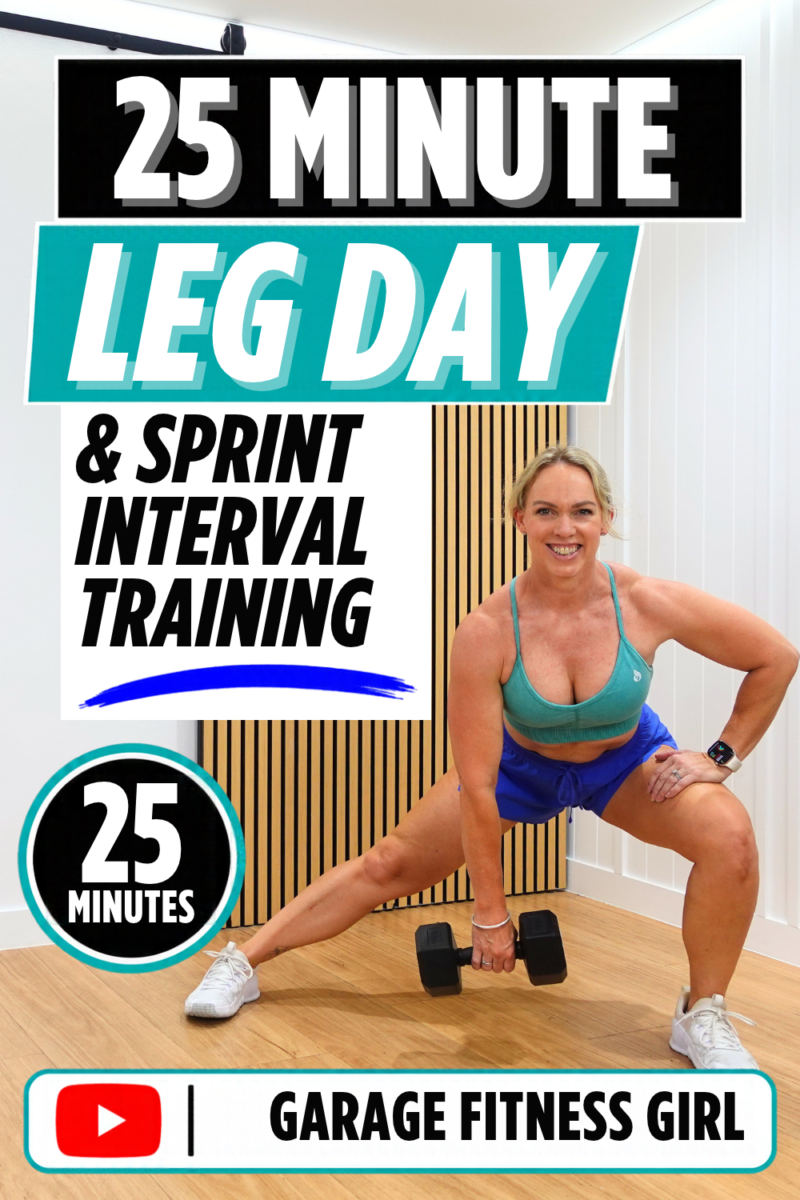
The Full Leg Day Sprint Interval Workout
Each strength tri-set includes 2 rounds of 35 seconds work and 15 seconds rest, with 30 seconds of recovery after the tri-set. Each SIT block includes 2 rounds of 20 seconds work and 40 seconds rest.
For the single-leg deadlifts, you’ll complete the full 35 seconds on each side.
Warm Up · 30 secs each
1️⃣ Squat Touchdown
2️⃣ Lunge with Front Kick
3️⃣ Lateral Squat Walk
4️⃣ Jog on the Spot
Tri-Set 1 | Quad Strength · 2 Rounds · 35s work / 15s rest
1️⃣ Offset Front Rack Squat | 10kg/22 lbs †
2️⃣ Alt Goblet Lateral Lunge | 10kg/22 lbs
3️⃣ DB Wall Sit | 10kg/22 lbs †
30 secs rest
Tri-Set 2 | Unilateral + Hamstrings · 2 Rounds · 35s work / 15s rest
1️⃣ Alt Reverse Lunge | 10kg/22 lbs
2️⃣ SL Deadlift (L) | 10kg/22 lbs †
3️⃣ SL Deadlift (R) | 10kg/22 lbs †
30 secs rest
SIT Block 1 · 2 Rounds · 20s work / 40s rest
1️⃣ High Knees †
2️⃣ Lateral Squat Jump †
60 secs rest
Tri-Set 3 | Glute Strength · 2 Rounds · 35s work / 15s rest
1️⃣ RDL | 10kg/22 lbs
2️⃣ Good Morning | 10kg/22 lbs †
3️⃣ Glute Bridge March | 10kg/22 lbs
30 secs rest
SIT Block 2 · 2 Rounds · 20s work / 40s rest
1️⃣ Mt Climbers †
2️⃣ Squat Hop Burpee †
Workout Complete! 🔥 Approximately 228 calories (my workout estimate).
† Exercises marked with this symbol have a modification demonstrated in the video.
Exercises Worth Calling Out
Offset Front Rack Squat. This is such a good variation when you want to challenge more than just your legs. By holding a dumbbell on one side of your body, you’re creating an uneven load that asks your core to work harder to keep you stable.
Focus on keeping your chest tall, your core braced and your weight balanced through your feet. You can switch which side holds the weight between rounds to give both sides an opportunity to work.
Single-Leg Deadlift. One of my favourite exercises for strengthening your hamstrings and glutes while challenging balance and control.
Working one leg at a time can help highlight differences between your left and right sides that you might not notice during a regular deadlift.
The key is to hinge from your hip rather than reaching towards the floor. Keep your hips square, your back long and move through a range you can control.
Struggling with balance? Keep your back toes lightly touching the floor for support. You’ll still get plenty of benefit from the movement.
Squat Hop Burpee. The final sprint of the workout, and we’re finishing with a little extra energy! 🔥 This variation combines a burpee with a squat hop to challenge your legs and cardiovascular fitness.
Focus on quick, controlled movement for the 20 seconds rather than rushing through sloppy repetitions. And if jumping isn’t for you, take the lower-impact modification shown in the video.
Remember, the goal is to challenge yourself at YOUR level, not match anyone else’s speed.
Trainer Tips
✔️ Choose weights that challenge you. By the final few seconds of each strength set, you should feel like your muscles are working hard without sacrificing form.
✔️ Don’t rush your strength repetitions. Controlled movement and good technique matter more than squeezing in extra reps.
✔️ Make your sprint intervals count. Work at a challenging intensity for 20 seconds, then use the 40-second recovery to prepare for your next effort. You don’t need to sacrifice control to go faster.
✔️ Modify the jumps when needed. Lower-impact options can still challenge your cardiovascular fitness. Focus on effort rather than impact.
✔️ Pay attention to your hip hinges. The RDL and good morning both challenge your posterior chain. Keep your core engaged, move through your hips and adjust your load if your lower back starts taking over.
✔️ Use your recovery periods. That extra 60 seconds after the first SIT block is there for a reason. Let your breathing settle before moving back into your strength work.
And one final reminder: you don’t need to finish every workout completely exhausted for it to be effective. Quality, consistency and gradual progression are what matter most.
Who This Workout Is Perfect For
This leg day sprint interval workout is for you if you enjoy challenging strength training but also love adding a little conditioning to your week. It’s especially useful if:
- You’re short on time but still want a productive lower body workout.
- You want to build and maintain lean muscle while improving your fitness.
- You enjoy lifting weights but don’t always want a separate cardio session.
- You’re comfortable with basic dumbbell strength exercises and want an extra challenge.
It’s also a great option for women over 40 who want to keep their training varied without losing sight of the importance of strength.
A quick note on modifications: This workout includes squats, lunges, single-leg exercises and jumping movements. I’ve included lower-impact alternatives for the sprint intervals, but if you’re currently dealing with knee pain or these movements aggravate your joints, I’d recommend choosing one of my dedicated knee-friendly workouts instead.
There’s always another way to train, and listening to your body is part of training smart.
Save This Workout
Want to repeat this session and actually track how you’re progressing? I’ve created a FREE interactive workout card to go with this workout so you can keep a record of your strength training rather than guessing what weights you used last time.
You can:
✔️ Record your dumbbell weights for both rounds of each tri-set
✔️ Tick off your completed sprint intervals
✔️ Save it digitally or print it out
✔️ Use it again next time to see where you can challenge yourself a little more
Because getting stronger isn’t about constantly finding new workouts. It’s about giving your body opportunities to improve over time.
👉 DOWNLOAD YOUR FREE 25 MIN LEG DAY & SIT WORKOUT CARD | INTERACTIVE PDF
What to Try Next
If you enjoyed combining strength and conditioning, here are a few more workouts you might love:
👉 Strength and Sprint Intervals Workout
👉 Dumbbell Leg Day at Home
👉 Floor Strength Workout for Women Over 40: A different way to challenge your muscles with controlled, floor-based strength exercises.
Frequently Asked Questions
Is this workout suitable for perimenopause?
Yes, for many women it can be. Strength training is particularly valuable during perimenopause because it supports muscle strength, bone health and physical function. The sprint intervals provide an additional cardiovascular challenge.
However, high-intensity training isn’t essential every session, so adjust the intensity to suit your recovery, energy levels and fitness.
What weight dumbbells should I use?
I used 10kg/22 lbs dumbbells throughout the strength blocks. Choose a weight that feels challenging towards the end of each 35-second interval but still allows you to maintain good form. That might mean using lighter or heavier weights depending on your experience.
Is this good for bad knee days?
This wouldn’t be my first choice for a bad knee day. The workout includes squats, lunges and jumping movements, which may aggravate certain knee issues. If your knees are bothering you, choose one of my knee-friendly workouts instead.
Can I do this workout as a beginner?
This is an intermediate workout, but you can adapt it if you’re already comfortable with basic strength exercises. Start with lighter dumbbells, use the lower-impact modifications and take extra recovery when needed.
If you’re completely new to exercise, I’d recommend building confidence with a beginner strength workout first.
How many calories does this workout burn?
My workout estimate was around 228 calories, but your actual energy expenditure will vary depending on your body size, fitness level, exercise intensity and the weights you choose.
Rather than focusing on calories, use the session to build strength, improve your fitness and feel good about what your body can do.
How often should I do this leg day sprint interval workout?
Once a week can work well as part of a balanced training schedule. If you’re training your lower body multiple times per week, allow enough recovery between challenging sessions, often around 48 hours, depending on the intensity and how you feel.
Do I need a gym?
Not at all! You can do this entire workout at home with one pair of dumbbells, an exercise mat and access to a wall.
What’s the difference between SIT and HIIT?
HIIT (high-intensity interval training) is a broad term for workouts that alternate challenging efforts with recovery periods. SIT (sprint interval training) typically involves very short, extremely intense efforts with recovery between bouts.
In this workout, we’re using sprint-style intervals of 20 seconds work and 40 seconds rest. The focus is on short bursts of high effort while maintaining good technique, rather than continuous cardio.
Ready to give it a go? If you’ve only got 25 minutes but still want to make your leg day count, grab your dumbbells and press play!
And when you’re finished, come back and tell me in the YouTube comments: What challenged you more: the strength tri-sets or the sprint intervals? 👇
I love hearing how you go with these workouts, and your feedback helps me create more of the sessions you enjoy.
Remember, you don’t have to train for hours to make progress. Keep showing up, challenge yourself appropriately and focus on getting stronger over time.
Strong, consistent and energised, not exhausted. ⚡
Penny x