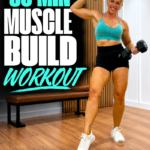
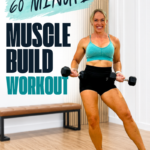


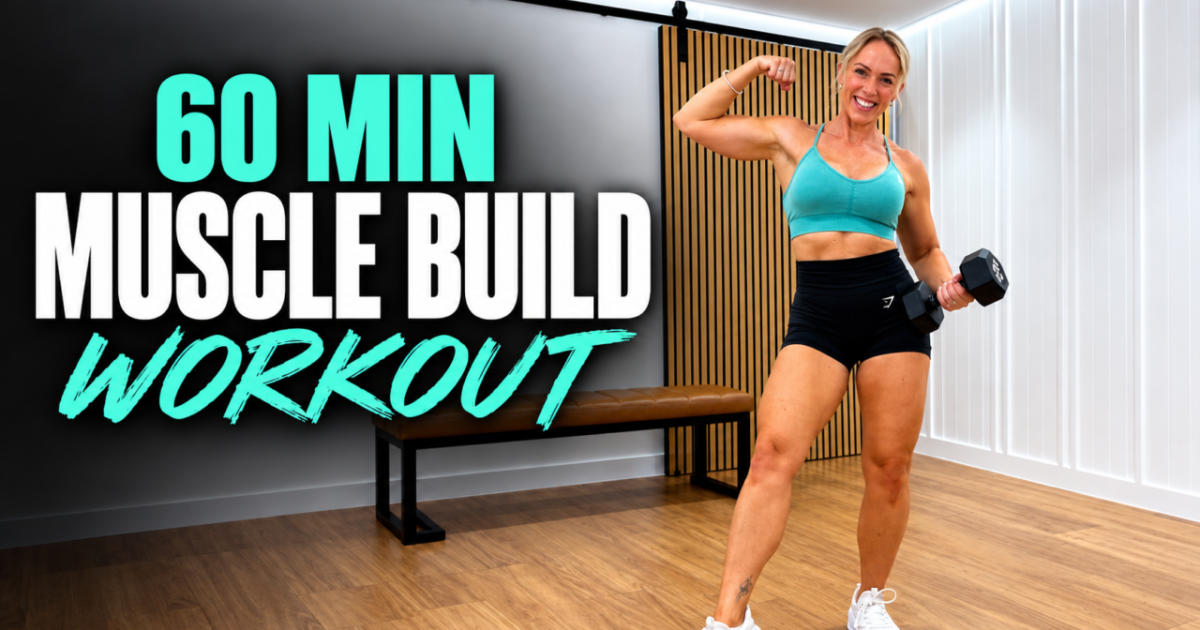
If you love a proper strength session that challenges your muscles from head to toe, this one’s for you! 💪 Welcome to Muscle Build 4, a 60 minute full body dumbbell workout designed to help you build muscle, improve strength and challenge every major muscle group.
We’re working through six focused strength tri-sets, followed by a targeted core circuit and an upper body finisher that’ll have your arms working right until the final seconds. Expect controlled lifting, plenty of muscle-focused work and that satisfying feeling of finishing a proper strength session.
A Full Body Strength Workout With a Little Something Different
I absolutely love putting these longer Muscle Build sessions together. There’s something so satisfying about giving each muscle group the attention it deserves rather than rushing from one exercise to the next.
This particular workout came together a little differently. I’d recently been dealing with a back niggle and had taken some time away from my usual training.
When I felt ready to return to a longer strength session, I wanted to incorporate more supported exercises without compromising on the challenge. That’s where the bench came in.
I started experimenting with different ways to use it throughout the workout, from supported rows and seated shoulder exercises to glute work and an entirely bench-based core circuit. And I loved the result!
What started as a few adjustments turned into one of my favourite full body strength combinations. The bench adds variety and stability, but the focus is still very much on challenging your muscles and getting quality strength work done.
This isn’t a rehabilitation workout, and the bench doesn’t automatically make every exercise suitable for an injury. It’s simply another useful tool for creating an effective, well-rounded training session.
Don’t have a bench? No problem. I’ve included modifications for every bench exercise, so you can still follow along with your dumbbells and a mat.
What You’ll Gain
- ✔️ Full body muscle-building work: Six targeted tri-sets covering your legs, shoulders, back, glutes, hamstrings, chest and arms.
- ✔️ Focused strength training: Repeated rounds give you the opportunity to work each muscle group with intention and maintain quality movement.
- ✔️ A different core challenge: Seven exercises performed on the bench to test your abdominal strength and control.
- ✔️ Flexible equipment options: Dumbbell alternatives and modifications for every bench-based exercise.
- ✔️ An upper body finisher: A descending-time challenge that’ll test your biceps and shoulders when they’re already feeling the work.
- ✔️ Strength that carries over: Compound movements, unilateral exercises and controlled lifting to develop strength you can use beyond your workouts.
Full Body Dumbbell Workout Overview
| ⏱ Duration | 60+ minutes including warm up and cool down |
| 🔥 Calories | Around 462 recorded during my session; individual results vary |
| 🏋️ Equipment | Three sets of dumbbells and a flat bench (modifications included) |
| 💪 Focus | Full body strength, muscle building, glutes, upper body and core |
| 📊 Level | All levels with modifications and weight options |
| 🎯 Format | 6 strength tri-sets × 2 rounds, a bench core circuit and a descending upper body finisher |
Why This Workout Works for Women Over 40
Building muscle deserves a place in your training. As we move through our 40s and beyond, maintaining muscle becomes increasingly important. Age-related muscle loss, combined with the hormonal changes of perimenopause and menopause, makes regular resistance training particularly valuable.
And it’s not just about how our bodies look. Strength training helps maintain muscle mass, supports bone health and improves our ability to keep doing the things we love as we get older.
That’s why I place so much emphasis on lifting weights consistently rather than feeling like every workout needs to leave us completely exhausted.
This session gives you a full hour of focused resistance training, with enough variety to keep things interesting and enough repeated work to properly challenge your muscles.
Six tri-sets. One strong full body session. Rather than moving randomly between muscle groups, I’ve organised this workout into six targeted tri-sets. Each tri-set brings together three complementary exercises, performed for two rounds.
We’re starting with legs before moving into shoulders, another lower-body block, back, glutes and hamstrings, and finally chest and arms. This approach allows you to accumulate quality training volume for each area while giving other muscle groups a chance to recover.
The 40 seconds of work and 20 seconds of rest keeps the session moving, but the aim isn’t to race through your repetitions. Choose weights that challenge you, control each movement and focus on making those working seconds count.
Unilateral exercises build strength and control. You’ll notice quite a few single-leg and single-arm movements throughout this workout.
I’m a big fan of unilateral training because it challenges each side independently, helps develop coordination and gives you an opportunity to identify strength differences between sides.
Think single-leg squats, step-ups, supported rows and hip thrusts. These exercises require focus and control, and they’re an excellent addition to a well-rounded strength routine.
Just remember that the goal is quality movement, not simply lifting the heaviest weight possible.
The core circuit and finisher bring it all together. Once our six strength tri-sets are complete, we’re moving into a seven-exercise core circuit performed entirely on the bench.
It’s a fun change from traditional floor-based abdominal work, with exercises like leg lowers, reverse crunches and in-and-outs challenging your ability to control your trunk and pelvis.
Then we’re closing things out with an upper body meltdown. Three exercises. Three descending work periods. 90 seconds. 60 seconds. 30 seconds.
Your arms will already be feeling the earlier strength work, so expect this final block to bring a serious burn! It’s a challenging finish, but remember: we want to finish feeling accomplished, not completely depleted.
The Full Body Dumbbell Workout
We’ll complete six strength tri-sets for two rounds each, working for 40 seconds with 20 seconds of rest between exercises, 30 seconds between rounds and one minute between the specified blocks.
Then we’ll move into our bench core circuit for two rounds at 35 seconds work and 15 seconds rest, finishing with one descending upper body challenge. I’ve included the dumbbell weights I used as a reference, but choose weights appropriate for your own strength and experience.
Exercises marked with an asterisk (*) have a modification demonstrated in the video.
Warm Up
1️⃣ Arm Circles
2️⃣ Standing Hip Circles
3️⃣ Lateral Lunge
4️⃣ Frankenstein Kicks
5️⃣ Inchworm
6️⃣ Quadruped Knee to Elbow (L)
7️⃣ Quadruped Knee to Elbow (R)
8️⃣ RDL | 5kg/10.5 lbs
9️⃣ Alt Shoulder Press | 5kg/10.5 lbs
🔟 Suitcase Squat | 5kg/10.5 lbs
Block 1 | Full Body Strength
6 Tri-Sets · 2 Rounds Each · 40s Work / 20s Rest
Tri-Set 1 | Legs
1️⃣ Suitcase Squat | 12.5kg/27.5 lbs
2️⃣ SL Bench Squat (L) | 8kg/17.5 lbs *
2️⃣ SL Bench Squat (R) | 8kg/17.5 lbs *
3️⃣ Wall Sit with Leg Extension *
30 secs rest
Tri-Set 2 | Shoulders
1️⃣ SA Shoulder Press (L) | 12.5kg/27.5 lbs
1️⃣ SA Shoulder Press (R) | 12.5kg/27.5 lbs
2️⃣ Seated 1 & 1/2 Lateral Raise | 5kg/10.5 lbs *
3️⃣ Front Press & Twist | 5kg/10.5 lbs
30 secs rest
Tri-Set 3 | Legs
1️⃣ SL Glute Focused Step Up (L) | 12.5kg/27.5 lbs *
2️⃣ SL Glute Focused Step Up (R) | 12.5kg/27.5 lbs *
3️⃣ RDL to Reverse Lunge | 12.5kg/27.5 lbs
60 secs rest
Tri-Set 4 | Back
1️⃣ SA Supported Row (R then L, switch sides at 20 secs) | 12.5kg/27.5 lbs *
2️⃣ Dumbbell Pullover | 8kg/17.5 lbs *
3️⃣ Seated Reverse Fly | 5kg/10.5 lbs *
30 secs rest
Tri-Set 5 | Glutes & Hamstrings
1️⃣ SL Hip Thrust (L) | 12.5kg/27.5 lbs *
2️⃣ SL Hip Thrust (R) | 12.5kg/27.5 lbs *
3️⃣ Heels Up Glute Bridge | 12.5kg/27.5 lbs *
30 secs rest
Tri-Set 6 | Chest & Arms
1️⃣ Incline Push-Up *
2️⃣ Lying Tri Ext to Press | 5kg/10.5 lbs *
3️⃣ X Body Curl | 5kg/10.5 lbs
1 min rest
Block 2 | Bench Core Circuit
2 Rounds · 35s Work / 15s Rest
1️⃣ Toe Taps *
2️⃣ Leg Lowers *
3️⃣ Knee to Elbow (L) *
4️⃣ Knee to Elbow (R) *
5️⃣ In & Out Abs *
6️⃣ Reverse Crunch *
7️⃣ Heels Up Bent Knee Sit-Up *
Block 3 | Upper Body Meltdown Finisher
1 Round · Descending Time
1️⃣ Curl to Press (90 secs) | 5kg/10.5 lbs
2️⃣ Alt Bicep Curl (60 secs) | 5kg/10.5 lbs
3️⃣ Iso Hold Curl (30 secs) | 5kg/10.5 lbs
Workout Complete! 🔥 Approximately 462 calories recorded during my workout.
Exercises Worth Calling Out
Single-arm supported row. One of my favourite ways to really focus on working the back.
With one hand and knee supported on the bench, you can create a stable position that allows you to concentrate on the rowing movement rather than maintaining an unsupported hinge.
Keep your spine neutral, draw your elbow towards your hip and lower the dumbbell with control. Avoid twisting your torso to lift the weight. Let your back muscles do the work.
Single-leg hip thrust. If you want to give your glutes some focused attention, this one’s a beauty!
With your upper back supported on the bench, the single-leg hip thrust challenges your glutes while requiring you to maintain control through your hips and pelvis.
Drive through your working foot, keep your hips level and squeeze your glute at the top. You don’t need to push into an exaggerated back arch to make this movement effective.
The bench core circuit. This might be my favourite section of the entire workout simply because it’s a little different!
Using the bench for abdominal exercises changes the setup and, depending on the movement, may allow a greater range of motion than working on the floor. But greater range doesn’t necessarily mean better.
The priority is maintaining abdominal control without allowing your lower back to excessively arch or your pelvis to lose position.
If leg lowers or in-and-outs feel too challenging, bend your knees or reduce the range. Your abs should be doing the work, not your lower back.
Trainer Tips
- ✔️ Choose your weights with intention. The final repetitions of each working interval should feel challenging, but your technique should remain controlled.
- ✔️ Set up before you press play. Have your dumbbells, bench and mat ready so you’re not rushing between exercises.
- ✔️ Focus on the muscle you’re training. This is a strength session, not a race. Slowing a movement down can make it more challenging without increasing the weight.
- ✔️ Make sure your bench is stable. Place it on a flat, non-slip surface and check its suitability for exercises such as step-ups and hip thrusts.
- ✔️ No bench? No problem. Most exercises can be adapted to the floor or a standing variation. Incline push-ups become kneeling push-ups, and step-ups can be replaced with kickstand deadlifts.
- ✔️ Respect your recovery. If you’ve been dealing with an injury or haven’t trained for a while, build back gradually and seek professional guidance when needed. Don’t use a supported exercise as a reason to push through pain.
- ✔️ Keep track of your progress. Record the dumbbells you use so that when you return to this workout, you can challenge yourself appropriately.
Who This Workout Is Perfect For
This 60 minute full body dumbbell workout is ideal for women who enjoy focused strength training and want to challenge their muscles without turning every session into a high-intensity cardio workout.
It’s particularly suited to you if:
- You want to build or maintain muscle through your 40s, 50s and beyond.
- You enjoy structured strength workouts with a clear focus.
- You prefer dumbbell workouts you can complete at home.
- You want a combination of compound lifts, unilateral training and targeted accessory work.
- You enjoy longer workouts that give every major muscle group some proper attention.
While the exercises can be modified for different fitness levels, this is still a challenging session. Choose your weights carefully, adjust the range of motion when needed and take additional recovery between sets if necessary.
And if you’ve only got 30 minutes today? Choose three tri-sets and give them your full attention. You don’t need to complete every minute to make your training worthwhile.
Save This Workout
Want to keep track of the weights you’re lifting? I’ve created an interactive Muscle Build 4 workout card so you can record your dumbbell weights, follow the exercise structure and track your progress each time you repeat the session.
You can fill it in digitally and save your results or print it and write your weights by hand. It’s a simple way to turn a follow-along workout into something you can progressively build on.
👉 60 Minute Muscle Build 4 Workout Card | Interactive PDF
What to Try Next
If you enjoyed this full body muscle-building session, here are a few more strength workouts to add to your training week.
👉 Floor Strength Workout for Women Over 40
👉 Full Body Barbell Workout
👉 Knee Friendly Standing Workout
Frequently Asked Questions
Is this full body dumbbell workout suitable for perimenopause?
Absolutely. Resistance training is particularly valuable during perimenopause and beyond because it helps maintain muscle mass, supports bone strength and improves physical function as we age.
This workout combines compound movements, unilateral exercises and targeted strength work to challenge your muscles across a full-body session.
What weight dumbbells should I use?
I used 5kg/10.5 lbs, 8kg/17.5 lbs and 12.5kg/27.5 lbs dumbbells throughout the workout. These are simply the weights I chose for my session, not weights you need to match.
Choose a load that allows you to maintain good technique while making the final repetitions of each interval challenging.
Do I need a bench for this workout?
No! While I use a bench for several exercises, I demonstrate modifications throughout the video.
Many of the movements can be performed on the floor or adapted to standing variations, so you can complete the workout using dumbbells and a mat.
Is this a beginner-friendly workout?
Yes, with modifications, although the complete 60-minute session may be demanding for someone new to strength training.
Start with lighter dumbbells, take additional rest and consider completing just one round of each tri-set while you develop strength and confidence.
Can I do this workout with a sore back?
This workout isn’t designed to treat or rehabilitate back injuries.
Although I incorporated additional support when programming it after my own back niggle had settled, that doesn’t mean every movement is appropriate for someone experiencing pain.
If you’re managing an injury or ongoing symptoms, speak with your physio or healthcare professional before returning to strength training.
How many calories will I burn?
I recorded approximately 462 calories during my session, but your individual calorie expenditure will vary depending on factors such as body size, intensity, exercise selection and rest periods.
Rather than focusing on calories burned, I’d encourage you to measure progress through your strength, movement quality and the weights you’re able to lift over time.
How often should I do this workout?
You could include this workout once or twice per week as part of a balanced strength training routine, depending on your overall training volume and recovery.
Because this is a full-body session, allow sufficient recovery before repeating another demanding workout for the same muscle groups.
Ready to Build Some Muscle?
There’s something I love about finishing a proper strength session and knowing you’ve given your muscles some focused, challenging work. And that’s exactly what Muscle Build 4 is all about.
Not chasing exhaustion. Not trying to burn as many calories as possible. Just showing up, challenging yourself and investing in the strength you want to carry into the years ahead.
Press play, grab your dumbbells and let’s get stronger together! 💪 And when you’re finished, leave me a comment on YouTube. I’d love to know what you thought of that bench core circuit!
Remember: strong, capable and energised. That’s what we’re working towards.
Penny x